Five days through layers of millennia-old history — where wild nature and ancient ruins coexist far from tourist paths.
Quiet Luxury · Historical Immersion · Deep Travel
Southern Sardinia has been continuously inhabited for over 8,000 years. Most visitors spend three days here and leave without noticing.
Bithia is the reason why.
An entire city is buried beneath the beach at Chia. Phoenician in origin, built on the foundations of a Nuragic settlement that already existed when the first Phoenician ships arrived in the 8th century BC. It became one of the most important trading posts in the western Mediterranean — Punic, then Roman, then abandoned in the 7th century AD when its inhabitants retreated inland to escape pirate raids from the sea.
For over a thousand years, nobody knew it was there.
Then in 1926, a storm eroded the dunes at Sa Colonia and the dead began to reappear — funerary urns, tomb structures, fragments of a civilisation that had been waiting under the sand. In January 2026, another storm did the same thing again: the sea returning what it had taken, on its own schedule, without asking.
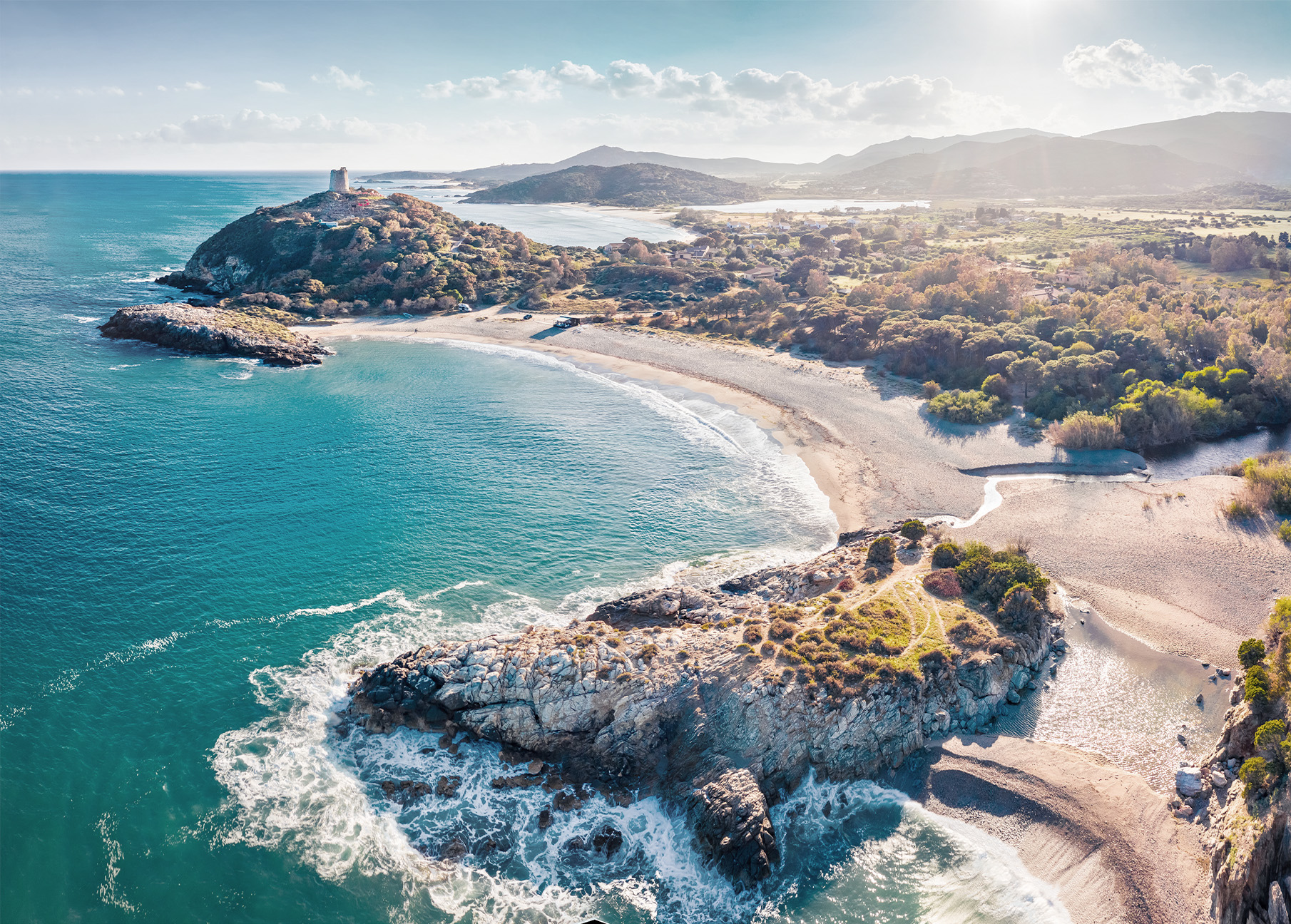
The Torre di Chia — the Spanish watchtower that has become the symbol of this coastline — stands on the exact promontory where Bithia's acropolis once rose. At its feet, the Temple of Bes. On the small islet of Su Cardolinu, the ruins of a Punic sanctuary that archaeologists believe may have served as a tophet. The statue of Bes — a squat, protective deity brought from Egypt by Phoenician traders — is now in the Archaeological Museum in Cagliari. Its absence from the site tells you something about how little of Bithia has actually been excavated.
Most of it is still down there.
Understanding this coastline means understanding that the beach you're looking at is not just a beach. It is a city. And the tower above it is not a picturesque ruin — it is the latest layer of a place that has been continuously occupied, contested, and defended for three thousand years.
Included experiences:
- Lequarci Waterfalls In the heart of the island, far from the coast, waterfalls flow among granite rocks and dense forest: natural pools, the scent of myrtle, and a silence the beaches never know. In Ulassai, in Ogliastra, they are considered the most impressive in Sardinia, with a main drop of over 50 metres and a width of up to 70 metres, followed by smaller cascades and rapids descending for another 75 metres in elevation. After a rainy winter, the flow is at its peak and the surrounding forest is greener than ever. The landscape is dominated by the Tacchi of Ogliastra, vertical cliffs covered in Mediterranean vegetation. Marked paths allow visitors to climb up to the upper edge for a panoramic view over the valley.
- Ruins of Nora
You will walk among the remains of one of the oldest cities in Sardinia, where time seems to stand still among Roman columns, mosaics, and the sea gently lapping at the edges of a unique archaeological site in the Mediterranean. Founded by the Phoenicians in the 8th century BC and later ruled by the Carthaginians and Romans, Nora preserves remarkable evidence from every era: the Roman theatre overlooking the sea, the baths with mosaic floors, the Phoenician-Punic temple, and the ancient forum.
Located on a peninsula in Pula, on the south-western coast, the site offers a striking setting where history and nature merge, with ruins emerging from Mediterranean scrub just a few steps from crystal-clear beaches.
- Ancient Roman road
You will follow the route once used by legionaries to cross the Sulcis, where exploring with a local guide completely changes the way the landscape is perceived. This consular road, built by the Romans to connect the mining and military settlements of south-western Sardinia, winds through valleys and hills covered with Mediterranean scrub.
Sections that are still visible preserve the ancient basalt paving, the ruts left by carts, and the remains of bridges and service structures. Walking on these millennia-old stones, accompanied by someone who knows every rock and every story of the land, transforms a simple excursion into a journey through time, revealing details invisible to the untrained eye and deep connections between the present landscape and that of two thousand years ago.
Some guests return with a new understanding of the island. Others return having simply walked where few walk.
Request Availability


_(1).png)